Showing posts with label Jerry Rees. Show all posts

Sunday, May 28, 2023

The Legend of Bill Moore

Bill Moore, 1981.                 Photo by Chris Wahl

Thursdays at CalArts were brutal.  Getting to class early to pin our assignments on the long crit wall, we'd wait to be slaughtered by the old man.   Upon his arrival, the room would go silent.  He would casually stroll along the wall, surveying our assignments in his sport shirt and slacks  (or Jordache jeans!), cigarette propped in a bent back wrist, like Tim Gunn and Humphrey Bogart's love child.   Welcome to Bill Moore's design class.  

You could hear a pin drop as we held our breaths, each hoping the Angel of Death would pass over their assignment.  At last he'd pause at someone's piece and say, "Who belongs to this?"  The owner of said piece would then have to stand and "qualify" their work - that is,  explain what they did and why it works while he challenged everything they said.  This went on for three excruciating hours until each of us had our turn hemming and hawing in defense of our work.    

I came to CalArts right out of high school - a Catholic, art-hating prep school at that.  I had ZERO knowledge of color and design theory.  So on a weekly basis, in front of the class, Bill murdered me.  Gleefully.   He gleefully murdered me so much so, he took to calling me "Zombie".

But 40 years on, Zombie lives, as does Bill's voice when I work on any creative endeavor.  I hear him reciting his design mantras, "Repetition with variation....contour continuity....".  And I hear his cold, judgmental prodding, "Is that the best you can do?"  Of all my CalArts teachers - men who had worked with Walt Disney personally -  I would have never bet the most influential would be a guy who never worked a day in animation, and in fact, held a general contempt for it.   
              
Bill's profound influence is almost universally shared among my industry peers, as is their fear and love of him.  Anecdotes have been shared and re-shared to great laughter over the years from those fortunate enough to have been there.  But his life outside of school has been a mystery, beyond stories he'd share for shock value or laughs.  So I did some research and interviewed many former students then cobbled together this piece.  It's not so much a biography as it is the story of a legend.  

Bill would hate it. 

                                                                                                                       photo by Chris Wahl

Saturday, April 3, 2021

Introducing....PeaceTime

After two years of working in fits and starts, I am very pleased to present "PeaceTime: A Royal Frog". 

I got this idea a while back (2017-ish?) as an answer to the loud and obnoxious programming that is fed to kids, ad nauseum, through 24-hour cable and streaming video - yes, the stuff that pays my mortgage.  I wrote the idea down in a sketchbook and let it ferment.   

At some point, I talked about it with my old friend Winter Reign, a far-out progressive gal with two small kids and no TV.  She loved it, somewhat surprised it came from such a Three Stooges loving, blue collar guy.  She invited me to a Kundalini yoga class deep in the heart of Topanga Canyon.  It seemed like a dare, and so I went. 

Saturday, August 8, 2020

Mr. Rees' Ukulele

 Last night there was a story on the local news about Harold Rees, a luthier (maker of stringed instruments) who was still at it at the age of 100.  For years, concert violinists have purchased his work, or entrusted him to repair and restore their precious instruments.  It was a really wonderful story made more wonderful by the fact that I know this man. 

Harold Rees is the father of my longtime friend and animation colleague Jerry Rees.  Over the past 35 years, I have seen Mr. Rees at Jerry's house on many occasions.  I've also seen many of his handmade instruments - violins, violas, banjos, and ukuleles.   After one such visit to Jerry's with my wife Donna,  she commented on the incredible craftsmanship in Mr Rees' work.  I confessed to her that I had always wanted to buy one of his ukuleles but was afraid to ask.

Sunday, March 6, 2016

Steve Speaks!

I was honored recently to be interviewed for The Tiara Talk Show, a podcast series created by Tammy Tuckey.  The show is about all things Disney, though it is not a Disney production.  Since its premiere in August of 2013, Tammy has done 103 interviews, with the likes of Debbie Reynolds, Ed Asner, Don Hahn, Jerry Rees, Gary Trousdale, and now me.  Slow news week, I guess.


Sunday, February 9, 2014

The Hunched and Goofy in Vanity Fair


The latest issue of Vanity Fair has a fantastic article on the genesis of the CalArts Character Animation program and the Hollywood heavyweights who got their start there.  Among them is FLiP's own Nancy Beiman, who is extensively quoted in the piece.  Congrats, Nancy!

Sunday, January 26, 2014

More Gremlins Redux

After Friday's posting about the 1992 development of the Roald Dahl Gremlins project at Disney TV Animation, Jerry Rees sent FLIP a bunch of images of the development art used in the pitch.  Enjoy!

artist: Jerry Rees  Frans Vischer

Friday, January 24, 2014

Disney and Dahl's "Gremlins" Redux

In 1992, I got to work on three great projects: The Nightmare Before Christmas, A Goofy Movie, and one that was never produced, Gremlins; not the Joe Dante Gremlins, but the Roald Dahl / Walt Disney one.

You cartoon buffs out there recall the Bugs Bunny shorts from World War II featuring little gremlins who tear apart Bugs' warplane in flight?  They were based on a short story by Roald Dahl done during the war for Disney Studios.  Disney was developing a feature from the story, but could not secure the complete rights, partially owned by the British Air Ministry, so he mothballed the project.  Dahl would release it in book form using Disney development art as illustrations.

Sunday, January 5, 2014

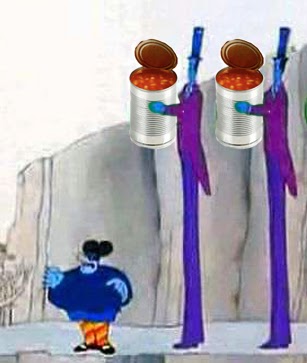
Bean Bonkers and Life as a Human Resource


Every business has its bean counters.  In the bean business, they have them in spades.  A team of bean counters determines exactly how many beans to place each can to yield the maximum profit for the company.  If a worker at the cannery should strive to create a better can of beans by adding more beans or being more selective of the beans to be canned, that employee would, after a few formal warnings, be canned themselves.

Beans are not art.  Art is not beans.  But sometime way back, the two were crossbred to create an abominable freak worthy of Dr. Moreau; the animation production.  In this business, there are people who try to create art and people who try to count beans.  Together, they fail miserably in their individual tasks, but produce a bi-product called the animated cartoon; neither art nor beans.

Saturday, November 9, 2013

My Most Influential Contemporaries


I have posted before about artistic influences, artists who I did not work with personally, but had a strong influence on my own work.  This time, I write about artists of my generation. In the past 30 years, I have worked with hundreds of artists, and many have influenced me in some manner.  Here is a list of five artists who, for me, had the greatest impact, in chronological order.  

1.  Dan Jeup – Dan was my roommate during my freshman year of CalArts, in 1981.  I knew next to nothing about Disney animation, though Dan was already animating at a professional level, and was an encyclopedia of Disney animation knowledge.  His passion for the medium was contagious, and I felt lucky to be asked along when he studied Disney film prints in the school library, pointing out different animation techniques.  Dan taught me about editing and match cuts and animating a character with weight.   And I taught him how to drink a lot of beer.

Tuesday, October 15, 2013

The Amazing Double Life of Jorgen Klubien

Dane Jorgen Klubien has lived in two parallel career worlds going back to the 1970's: one as an animator and story man for studios such as Disney and Pixar, the other as a Danish pop star.  It's a safe bet to say he is the only one in the world with that distinction.  He took a little time out to talk to FLIP.


FLIP:  Can you tell us about your music career?

Jorgen: I began playing the drums in bands in Copenhagen as a boy in the early 1970's.  We were four pals from school and we played high schools dances, etc . I always thought of myself as an artist who would become a fine artist with playing music for fun on the side.

I enrolled in the Danish Design school at 17, and was then invited to attend CalArts two years later.   My music career was put on hold until I returned to Denmark after having assisted Glen Keane, Jerry Rees, and Randy Cartwright on The Fox and The Hound for a year.  Back in Denmark I began writing songs with friends and soon thereafter I was in another band, this time as the front man and lead singer. We had a few hits in the mid 80's in Denmark and we have continued to play for fun every so often.

I returned to the US in 1982 to work on a title sequence for the show Animation Around The World, one of the first shows on the newly formed Disney Channel.  It was produced by my friend and classmate from CalArts, Rick Heinrichs.  He's been a great supporter of me throughout the years, and  has pulled me unto such great productions as The Nightmare Before Christmas and lately, Frankenweenie.

Wednesday, August 28, 2013

Remembering EPCOT's Cranium Command - Both Versions


There are some great posts on The Disney Project blog about Jerry Rees'  work for Disney Imagineering, including EPCOT's Cranium Command, where you go inside the mind of a boy as he goes about his school day in real time.  An animatronic figure interacts with characters representing different parts of the body, which constantly react to what is being seen through the boy's eyes.  It was an extremely complex show, logistically.

Like many of Jerry's jobs for Imagineering, Cranium Command was a rescue mission.  As The Disney Project blog puts it, "The project, already halfway through production at Colossal Pictures, was unanimously loathed by everyone at Disney. Jerry was tasked with reviewing the project, assessing its weaknesses, and fixing them."

I, personally, have the unique distinction of being the only animator to have worked on both versions of this show.  In January of 1989, Colossal Pictures producer Heather Selick hired Vince Davis and me as sort of animators-in-residence at their San Francisco studio.  She put us up in apartments on Union St in North Beach, just below the Coit Tower and just two uphill blocks from an area full of blues bars, cafes, Italian restaurants, City Lights Bookstore, and  really old strip clubs with creepy guys in big suits trying to get passersby to go in.  Far out!

Tuesday, May 28, 2013

My Awesome 21st Century Upgrade to Disneyland's Peter Pan Ride


I've had this idea for about eighteen years now.  I have no way of making it happen, but I do have an outlet to share the idea with you Imagineers out there, boldly assuming you haven't already considered this and abandoned it for some reason.   Here goes.....

I propose an entirely new Peter Pan ride, where you are sprinkled with pixie dust, think happy thoughts, then fly, actually fly, like Peter, Wendy, and the boys over London to Neverland.  You would not be in a fake boat riding on a clanky overhead rail.  You would be completely untethered.  What's the secret?  

Monday, January 28, 2013

Toaster Tales #2: A Letter to Mom and Chinese New Year

Toaster Crew in Taipei, 1986.  From left: Joe Ranft, Sanvy from Cuckoo's Nest, Steve Moore, Randy Cartwright, Brian McEntee, Jerry Rees, Chuck Richardson.    Photo by Rebecca Rees 
In January of 1986,  eleven Americans travelled to Taiwan to work on The Brave Little Toaster.  There was Jerry and Rebecca Rees, Chuck Richardson, Brian McEntee, Kevin Lima, Tanya Wilson, Chris Wahl, Ann Telnaes, Randy Cartwright, Joe Ranft, and 23 year-old me.  The studio was called Cuckoo's Nest, a cartoon factory which had been churning out miles of Saturday morning cartoons for Hanna-Barbera and Ruby-Spears.  The studio's owner, James Wang, paid to bring out about half of the American crew to shore up his talent pool.  Toaster raised the bar for his studio in every capacity.  Just compare Cuckoo's Nest productions such as The Smurfs to Toaster to get an idea of how far they were pushed.

 I recently found a letter I wrote to my parents from Taiwan, which unearthed some forgotten memories. So if you ever wondered what it was like to make a great American cartoon in the land of Chiang Kai-shek, read on!

Monday, November 12, 2012

TRON 30th: Memories From the Grid (and Beyond!)


TRON dropped audiences into a glowing realm of Bits, Programs, Systems and Game Grids – the unseen computer world manipulated by its Users. As one of the Users on the original crew I still feel that glow in memories that refuse to fade.

Sunday, July 22, 2012

Remembering Mr. Z


I was saddened to read of the passing of Richard Zanuck, film producer and one time head of 20th Century Fox.  What many of you may not know is that Richard Zanuck,  producer of Jaws and Driving Miss Daisy, once had a connection to animation, and I was part of it.

In 1993, the Zanuck Company began pre-production on a Betty Boop feature to be done through MGM Studios.  It was the baby of Richard Fleischer, veteran director of films such as 20,000 Leagues Under the Sea,  and Fantastic Voyage.  His father was Max Fleischer, who, with Uncle Dave, created a studio which at one time rivaled Disney.  Their star was Betty Boop.  Richard Fleischer inherited the rights to Betty, and approached Zanuck, an old friend from their days at 20th Century Fox, to make a Betty Boop feature.


Jerry Rees and Steve Leiva were hired as producers and they, in turn, hired me to direct. We began the development process with a small crew in a Burbank office building.
There were weekly meetings at the Beverly Hills offices of The  Zanuck Company, in Richard's office.  My first time there, Richard Zanuck stepped out from behind a huge desk, shook my hand and said, "Dick Zanuck.  Nice to meet you."

I never, ever, called him Dick.  This man was Hollywood royalty.  He produced some of the best films ever done.  His father, Darryl F. Zanuck, MADE 20th Century Fox.  This was Richard Frikkin' Zanuck, man!  "Dick" was just way too familiar, too equal par, for a first time director from South Jersey.  I called him Mr. Z.  
Richard and Lili Zanuck winning Oscars for Driving Miss Daisy.
Entering his office, to the right, was a seating area with matching gold couch and chairs surrounding a heavy duty coffee table.  In the two dozen or so meeting I had there, the seating arrangement never changed.  As the last hired of the group, I got the only seat left - the ottoman.  To my left, sat Jerry Rees, then Steve Leiva. Lili Zanuck, Richard's wife and business partner, sat on the couch directly across from me.  To her left was Richard Fleischer (who also insisted on being called Dick), then Mr. Z in His chair.  

At the start of one such meeting,  he looked to me and said, "Steve, you always get the ottoman." 

As I was shrugging it off, Lili patted the couch next to her and with a flirtatious smile said, "You can sit over here."  

The room erupted in laughter as my face turned beet red. I stammered, "Ohm uh....I'm afraid of you."

Richard laughed out loud. "Afraid?  She hasn't even gotten started yet!"

The fear I mentioned was in reference to her tendency to explode in meetings.  Lili's a petit, gorgeous woman with a razor sharp wit and vocabulary that could make Bluto blush. Inevitably, in every meeting,  she would get into a nuclear argument with Steve Leiva.  Steve liked to preach about filmmaking, and Lili would have none of it.  She would tear into him with a bombastic barrage which, for the layman, would kill them instantly.  But Steve kept coming,  not conceding an inch with a haughty snort.  Lili would go apoplectic. The sound of Steve's voice would make her squirm on the couch, twisting her body away from him.  She would place her hand to her brow to block him from peripheral view, all while continuing her verbal mauling.  It was simultaneously hilarious and painful to watch.  Eventually, Richard, or "Bully" as she called him, would step in, and he and Fleischer would have the final word.   

Six months into pre-production on Betty Boop, regime change at MGM put the project in turnaround. We set up a Boop pitch room at The Zanuck Company,  which stayed up for a few years as they tried to set the film up at other studios.  But Fleischer's Boop deal was not favorable.  Studios wanted to control the merchandizing revenue, so the project died.   The artwork, reels, and recordings generated over that time were dispersed among the crew.
  
Betty Boop Movie Development painting by Fred Cline
It was through Richard Zanuck that I met musician and friend Bennie Wallace.  Bennie did several demo recordings for the film.  He would later score my 1997 short Redux Riding Hood and 1999's The Indescribable Nth.  I can't imagine these films without Bennie's score, but without Richard Zanuck, we would have never met.  I sent Lili a copy of The Nth, and she was so kind to call me with compliments.  She's tops in my book.  My heart goes out to her, dealing with the loss of her "Bully". 

Years after Boop, I called Mr. Z.  His secretary didn't remember me, took my name and number, and I figured he'd get back to me eventually, but he's a very busy man.  He called me that same afternoon.  I thanked him for that, and he said his father told him to always return calls on the same day, no matter what.  

He was truly a class act, and Hollywood is a more terrible business without him.    
   
-Steve

Read more about The Boop Movie here.

Sunday, January 29, 2012

Jerry Rees' Home Movies of Ward Kimball

Back in the day, Rebecca and I were delighted to receive an invitation to attend a gathering at Ward Kimball's house.  Kelly Kimball was there of course.  Brian McEntee and Chuck Richardson were there.  Ward and his crew fired up full size steam engines and gave visitors rides back and forth across his property.  What a blast!  And what a shock it must have been for people passing on the neighborhood street, seeing steam engines racing toward the fence, then slowing at the last moment and edging up to the bumpers at the end of the tracks.  Most of the day was spent chatting, eating and riding the trains.  But Ward saw several of us peeking at the building where he kept his vast collection of miniature trains.  He let us in and asked "you want somethin' to run?"


He fired up several trains at once and got everything chugging.  You could tell he was having a blast!  Boy did his eyes twinkle...

Later that day he wanted to see the tapes I'd been recording.  He said he liked the footage better than the stuff a news crew had staged and shot earlier.  He found it more candid and fun.

That VHS tape has been sitting on a shelf for a whole lot of years.  After intending to digitize it for a long, long time, I finally gave it a shot.  Some of it is still in decent shape.  But there are segments lost to tape degeneration.  I could kick myself for not doing it sooner!  But over the next few weeks I plan to go back and salvage as many scenes as possible - both the big trains, and the miniatures - and post it all on my site.


The piece I shared today was just the first test (before the digitizer broke!).  I've ordered a new one and will be back at it in a few days.

Hope it made you smile!

Wednesday, January 18, 2012

Augmented Reality Without Mushrooms

"Reality is merely an illusion, albeit a very persistent one."
 -"Big AL" Einstein

Last month, I was shown this video by my old pal Jerry Rees. 


My head fell off.  A week later, I saw this one, below (skip to about 1:30 to get to the interesting stuff).  

Now, I’ve been around long enough to say I’ve been around long enough.  And for the first time in years I saw something animated that really blew my mind.  How do they do it?   Jerry explains “Augmented Reality” and his work with AMUSME, a start-up new-tech company he has been working with as Lead Creative.

Jerry Rees: 
"Augmented Reality (AR) is a process that allows web cams and/or smart mobile devices to show you a live image of what is actually there (the Reality part), plus an added element that isn't actually there (the Augmented part).  Software locks the Augmented element to the scale and perspective of a preordained marker in the real space.  This "tracking" to the marker is essential in making the added element seem to be part of the physical world.  When you move the marker in Reality, the Augmented element moves right along with it.

Old school tracking markers used to be blocky black & white symbols.  We now use image recognition.  This allows the app to "recognize" almost any image, such as a face or a logo and launch the software.

The term Augmented Reality is used pretty indiscriminately by many companies, often referring to a flat overlay that doesn't track, or just a link to a traditional website or video playback. 

We are excited to push the AR envelope with true 3D animation that tracks the real world and includes original music and sound.  We aim to create involving experiences and we aim for high quality.  Since AR places extreme limitations on the amount of data that can be streamed live, we are constantly exploring work-around strategies to elevate the sense of production value.  One day soon, cloud computing and hardware advancements will work together to remove most of these limitations.  Until then we valiantly joust!

When planning out the Augmented Reality pieces, I start with sketches.  I storyboard the expected attitudes and action.  My storyboards for Owney included plans for him to sit up and beg, catch a little envelope in his mouth, toss it back to you, bark, trot and run.  The idea was for updates of the app to feature Owney doing more and more interactive tricks - to display more and more personality.

Our Maya animator Jeff Clifton started building Owney in 3D, keeping in mind his required activities.

I rendered a pose test cycle to establish a cadence for Owney's trot.  I gave this reference video to Jeff as a timing guide for his animation.  I also gave it to our composer, Ian Rees, as a timing guide for his music.

Looking at historical photos I painted the flat Owney fur textures for Jeff to wrap around the Maya model.  This was the only fur solution available to us since Augmented Reality cannot yet handle the heavy data required to move thousands of fur strands.

Jeff sent me animation dailies married to Ian's music, and we tweaked various drafts.

But Jeff's challenges went far beyond traditional animation.  He had to collaborate with the software techs who were providing us the playback tools which track our animation to the physical marker.  Not only were there strict restrictions on the amount of data, but different tracking software uses different rendering environments as well.  So Jeff had to keep simplifying the data load while laboring to preserve the quality of our character.  And he had to work within the software language parameters of each vendor.  Not easy.  But he has become a top practitioner in essentially outsmarting the medium - especially as we followed up the Owney AR release with other projects such the JFK stamp, a dynamic Captain America movie promo and more.  Randy Cartwright has become an invaluable consultant, brainstorming with Jeff on best new methods.

A web portal allowed us to view tests on how smoothly the animation moved in the AR software environment, how well the sound stayed in sync, and how well the animation locked to the physical marker as you moved it around.  There were a number of trouble-shooting passes to smooth things out.

Once we were happy, the Apple apps team ran Owney through his paces.  He got a clean bill of health!

On some of the projects I've used Photoshop plus 3D layers in After Effects to do a more elaborate animatic of how the final experience should appear.  This process has allowed some of the textures and layers I build during pre-viz to be incorporated as hybrid aspects of the Maya model and the final app.

Currently my directing duties at Imagineering are keeping me from participating full time, as I did for the first year of our AR venture.  But the AMUSME team is going strong and I keep throwing in my two cents until I can dive back in!  We've started collaborating with computer science faculty members at various universities.  So many breakthroughs are just about to happen and we are poised to secure a perch on the front of the next wave.  Fun will be had by all!"
Jerry and Stephen Michael Schwartz wrote a 69 page version all based on newspaper articles vetted by Smithsonian.  Free at the iTunes app store for iPad.
http://itunes.apple.com/us/app/owney-tales-from-the-rails/id488657528?mt=8

For those without an iPad there's a web version link.
Fred Cline did awesome illustrations in the classic Golden Book style.

And there's the companion Augmented Reality Owney we released earlier:
http://postalmuseum.si.edu/owneyapp/


And finally, here's a video Jerry did of the "Owney" theme, using Fred Cline's illustrations.  The song was written by Stephen Michael Schwartz, performed by country singer Trace Adkins


-posted by Steve