Thorfinn, aka Richard Morgan - the nicest viking indeed.
Richard Morganhas authored and Illustrated heaps of childrens' books in the UK, such as his latest series Thorfinn the Nicest Viking. I met him in New Zealand working on my Redux Riding Hoodshort, and we've been long distance pals ever since. He shares with FLiP his plans of bicycling to raise money for cancer research.
by Richard Morgan
My daughter and I have started cycling together during the lockdown and felt we wanted a goal, so we joined the Cancer Research UK Cycle 300. I lost my Mum and my wife's Gran to cancer, plus I have lost several close friends to this disease and seen the horrible upset it leaves in its wake. However, I have also seen close friends fight and beat cancer due to the amazing treatment available now.
Living in Cambridge, its all road bike for us. We've been building momentum since the Tour De France came to visit. I have always cycled its like second nature. I got my first bike from
Ellis Briggs in Shipley, Yorkshire, and rode it everywhere. As I
learnt to drive I got a mountain bike and took it to the lakes in
Cumbria to hoon down mountains. When I moved to Auckland NZ to work for
Disney*, I treated myself to a new Marin and cycled all over, it was
amazing. So at 53, this seems like a wonderful thing to be doing with my
daughter before she goes off to university in September, hopefully!
The cycle is over the whole of September and my daughter is keen to do it as lots of short rides and avoid the pain in the bum. I would rather do one or even two bigger rides for the adventure, so we will see who wins. I will be updating the charity page as we do the rides so you can see us on the road and follow our progress.
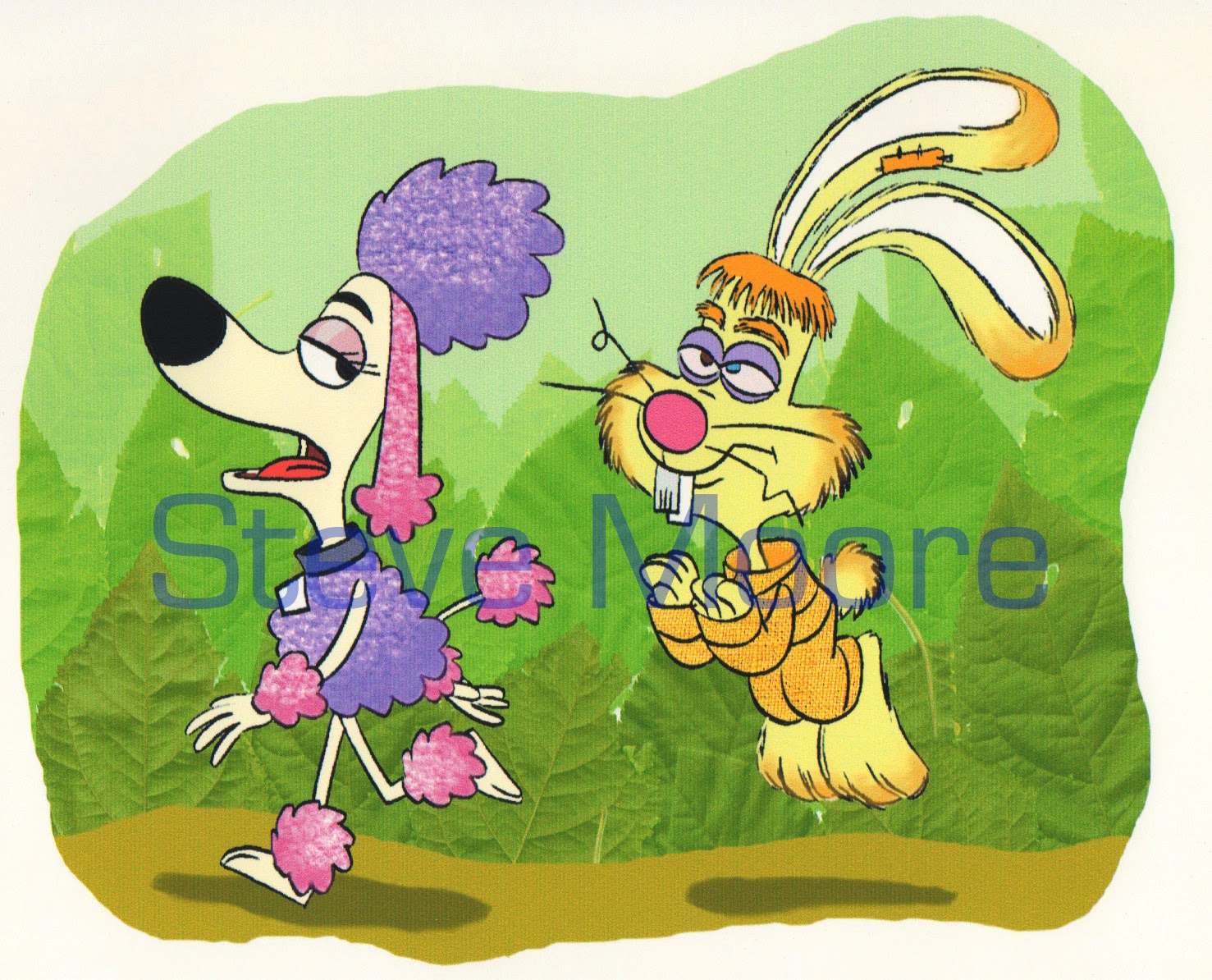
Brandy, an upper crust pure breed, is shipwrecked in the Amazon jungle with Mr. Whiskers, a bunny used for science experiments.
Does anyone out there remember a show calledBrandy & Mr. Whiskers? No? It ran from 2004 to 2006 on The Disney Channel. Last night, I came across some forgotten design work I did for that show at this time of year in 2002. I was freelancing then, and Disney TV Animation hired me to design characters for the show, in its early development stage. Barry Blumberg was in charge of DTVA then, and instructed me to come up with something really far out, maybe some mixed media stuff, like the photo collage elements I used in Redux Riding Hood, which DTVA produced and everyone loved but didn't love enough to release on DVD.
I have posted before about artistic influences, artists who
I did not work with personally, but had a strong influence on my own work. This time, I write about artists of my generation. In the past 30 years, I have worked
with hundreds of artists, and many have influenced me in some manner. Here is a list of five artists who, for
me, had the greatest impact, in chronological order.
1. Dan Jeup –
Dan was my roommate during my freshman year of CalArts, in 1981. I knew next to nothing about Disney
animation, though Dan was already
animating at a professional level, and was an encyclopedia of Disney animation
knowledge. His passion for the
medium was contagious, and I felt lucky to be asked along when he studied
Disney film prints in the school library, pointing out different animation
techniques. Dan taught me about
editing and match cuts and animating a character with weight. And I taught him how to drink a lot of beer.
One thing I love about our business is getting to work with stars of my childhood. In 1998, it was Frank Gorshin, one of the greatest impressionists of an era chock-a-block with them. His three impressions of Kirk Douglas - young, middle aged, and old - in The Big Story are sublime. And of course, he is the only Riddler that counts.
I was coming off Redux Riding Hoodand looking for a project. Sharon Morrill, my boss at Disney TVA, was having trouble with the reels of Hunchback 2 - one of those wretched cash cow direct-to-video sequels. The script was a paint by numbers dog, the songs Irving Cohen rejects. But Sharon let me do Redux, she was in a jam, and I'm a loyal sap. I dove into the Seine after Quasimodo, or in this case, the not quite Seine.
They wanted to recast the villain with a comic actor, someone who could inject some humor into the role. I suggested Frank Gorshin, and was soon on a jet to New York to record him. How many times did I see Frank Gorshin on Batman, or The Mike Douglas Show? And now here he was, waiting for me in an old Manhattan office building. He shook my hand, and started a conversation, but interrupted himself "Can I smoke in here?" he asked.
"Balcony." someone said.
Frank invited me to join him, and we walked down a short hallway. He opened a metal fire door to the 'balcony' - a wrought iron fire escape fifty two stories up. We stepped out, just enough room for two people once you shut the door. Frank lit up, and there I was, that little kid watching Batman on the floor of the TV room, standing toe to toe, literally, with The Riddler on a rusty fire escape 520 feet above Manhattan.
Making small talk under these circumstances was a bit challenging. I remember thinking, "What if he pushed me off this fire escape?" I knew he wouldn't do it. Probably not anyway. But what if he did? Or what if the wrought iron gave way? I wonder where we'd land? If someone throws this door open, it could knock me right off. Oh shit, I'm not saying anything. Say something. Don't talk about the Riddler, he might hate that, then you'll have a pissed off Riddler standing close enough to bite your nose off. He probably wouldn't do that, but just don't mention The Riddler.
"I used to watch you inThe Kopycats." I said, pulling one out of me arse.His face lit up. He loved doing that show, though it was only on for one season. He seemed happy that someone remembered. Just as we were bonding the door opened, whacking me square in the back. If not for the monkey grip I had on the rail, this story would have a different ending. And a different author. A woman behind the door apologized for nearly killing me and told us they were ready to start the session.
Frank delivered, but Sharon and her toadies were less thrilled. They somehow thought he could take their straight, dull, stock villain dialog and create a character as memorable as The Riddler. When I reminded them that there was: A) No humor in the character as written, and B) Only one four hour recording session to do all his dialog, I only succeeded in antagonizing them.
Ultimately, Uberboss Eisner's beef was not with Gorshin's performance. He didn't like the story and didn't like the songs. Who was to blame? The guy not invited to the meeting: me. It wasn't The Riddler who shoved me off the fire escape, it was Quasimodo.
-Steve
Gorshin voices three Kirk Douglas-es in David Toten and Tim Watts' BAFTA winning The Big Story.
A pencil test of the short is below....
I got an e-mail from a student, asking me if there was any way to be seen as successful without working at a big studio.
My answer: no.
For you industry people out there - when people find out you work in animation, what's The Big Question they ask?
A) Do you work for Disney?
B) Do you work for Disney?
C) Do you work for Disney?
or
D) Do you work for Disney?
I'm 50 years old, been working in animation for more than half of my life, and STILL get asked this question. For all the corporate crap that goes on at big studios, working at one means you have made it to the big leagues. And Disney is still the New York Yankees of animation studios. And like the Yankees, fans have high expectations and like to boo management.
First of all, a HUGE public thank you to Jerry Beck, the patron saint of cartoons, for posting about Redux on his Cartoon Brew site. The ensuing avalanche of YouTube views exceeded 15,000 in 48 hours. Yikes!
So now that you've seen the film, here's some useless information to store in your head:
1. Most of the photo cut-out elements came from a Montgomery Ward catalog from the 1940's owned by production designer John Kleber. He xerox'ed the entire catalog for our production purposes. The catalog had live chicks, and kits to build an entire house yourself.
2. In order to sufficiently tone down his voice during the depressed Wolf scenes, Michael Richards recorded those lines while lying on the floor.
3. Grandma is a caricature of my maternal grandmother, Bertha Davis. She also appears in the movie Bebe's Kids.
Grandma Davis, left, with my Aunt Viola at Disney World's Contemporary Hotel, 1972.
4. The photo over Grandma's bed is my maternal great-grandmother, Louisa Schmickel, who lived to be 100.
5. Grandma's house is pink because she's a faded red. It's a color pun, a bad one at that.
6. Next to the door in the Wolf's garage is a shovel and two bags of sheep manure. A side business for Doris?
7. The boy in the photo on Grandma's dresser is my nephew, Henry Moore. In one shot, it is background painter Richard Morgan.
8. To entice Fabio to do the part, the Woodsman's role was padded by storyboard artist John Norton, who added the "Mr. Bunny Rabbit." lines.
9. Don Rickles couldn't keep our names straight, so he called us all "Richie."
10. In the final sequence, where hundreds of wolves make plans in the kitchen, there's a wall map with a red X. That address was the location of Toonz Animation in Auckland, New Zealand.
11. The final shot is a take-off on Alfred Hitchcock's final shot in The Birds.
Okay, that's eleven pieces of worthless trivia. I'm glad to have so much interest in a short I thought was forgotten. Thanks for watching and spreading the word.
In September of 1995, at Disney TV Animation, Veep Sharon Morrill asked if I would like to direct a Fractured Fairy Tales type of short, and have stylistic free reign.
"Say that last part again?"
Free reign. Go crazy with it.
And so I began working on Redux Riding Hood, a short that would take me to the sixth row at the Oscars. Dan O'Shannon, one of the top sit-com writers around, had written a script about a wolf who, obsessed with his failure to catch Red Riding Hood, builds a time machine to go back and do it right. It was Dan's concept, and the script was hilarious.
Even with a great script, there are plenty of ways for the final product to fail. I set to work on the big stuff: production design, cast, and musical score.
Redux needed a production designer who had never worked in animation, someone not schooled in animation history, not influenced by classic cartoons of yesteryear. Dan Rounds, who I'd worked for on A Goofy Movie recommended a fishing buddy of his in New Mexico named John Kleber. When I saw John's work I knew, from the color palette to the use of textural and photo collage elements, I had found my production designer.
John Kleber artwork. Pieces like this were the springboard to the Redux production design
The first thing John wanted to know was if there were animated films he should view as reference. "NO!" I said, and forbade him to look at ANY animated cartoons while we were doing this project. The only other limitation I put on John was, because of our schedule, the style would need to allow background painters to work quickly.
I had a few meetings with casting director Jamie Thomason, who questioned me about the characters - what kind of person was the Wolf, Doris, Red, Granny, etc. Once we had talked out who the characters were, the casting choices became self-evident. Michael Richards was the manic Wolf. Mia Farrow, as his long suffering wife (I made her a sheep, animation's first inter-species marriage.) I liked Mia's casual delivery and the sound of her plaintive voice was a great counterpoint to Richards' abrasive sound. Writer Dan O'Shannon hated Mia's Doris, because she didn't have that sit-com cadence. He wanted her recast, but I held my breath longer and won out. I could go on and on about the cast - Lacey Chabert, Adam West, Fabio, June Foray, Don Rickles - but for now I'll just say I hit the jackpot. And Jamie Thomason is truly brilliant. There's no one else I would want in a recording session than Jamie.
For music I wanted jazz great Bennie Wallace. I had met Bennie during the ill-fated Betty Boop feature in '93. He knows more about music than anyone I have every met. When I described the project and the off-beat quality of it, he brought me Charles Mingus' album Mingus Mingus Mingus Mingus Mingus. Like John Kleber's artwork, I was immediately inspired and excited as a new layer of the film revealed itself.
With Mingus as inspiration, Bennie set to the task, casting his musicians to get the right sound - among them Robben Ford on guitar, Emil Richards and his magic box of percussion instruments, Art Baron and his mad trombone, Alex Acuna brought a Latin beat on drums, and Bennie himself on Sax.
We recorded at Capitol Records in Hollywood, in Sinatra's old stage. As the musicians assembled, Disney's music veep Bambi Moe asked Bennie to see the cue sheets. When she saw them, her head exploded. "WHERE ARE THE NOTES?!" the large orafice on her head shouted.
Bennie laid on his Tennessee drawl. "Bambi, this is jazz." He said, "You don't tell these guys how to play." Bennie was right. He had indicated general timing cues and tempo, but the rest was improvised. When the musicians performed, it was magic. I got goosebumps, and was truly depressed when they finished. I wanted them to play all night.
Here's the end credit cue with full band. Bennie and Art Baron have a musicians' joust. The spontaneity of this could not have been reproduced from transcription.
Disney TV President Dean Valentine loved the music, but said, "Jazz is for having a cigar and scotch. Not cartoons." This time my head exploded. How could this guy be in charge of an animation studio and have no knowledge of the history of the medium? I was seriously outranked on this fight, and the score would have surely been scrapped without the intervention of Peter Hastings. Peter's One Saturday Morning cartoon block was a huge hit, so he was one guy who Dean trusted. Peter gave the score his approval, and it was saved.
Thanks Peter!
I got to spend five months in New Zealand for production - what a beautiful country. We did our best with a fairly green crew. Lily Dell did some amazing work on the Wolf and animated the Time Machine combining cut-outs and drawings. While in New Zealand, Jeffrey Katzenberg called me from DreamWorks. I thought it was a friend doing a prank, so I played along rudely. Then it struck me. "This really is Jeffrey Katzenberg."
"Yes it is," he said, "the horse's ass."
I have no idea how he found me, or that he even knew who I was. He wanted me to call him when I got back. I only mention it because it was so bizarre.
Back in the States, the post mix with Dave Stone's awesome sound effects - his custom made Time Machine sound is hilarious. We did some festivals, went to the Oscars, lost, and then the film was put away. Seven months after the Oscars, I was shown the door.
I won't go into that ugliness.
In the years since, Michael Richards had his infamous night club blow-out. Garrison Keillor, our narrator, has made some less famous blow-outs. I don't know if that has hurt the chances of a Redux release, but I hope not. No one at Disney or on my crew endorses the backward thinking of two actors in the cast. And while I dish about some now ex-Disney execs, in the big picture, Sharon, Bambi, Dean, and all the Disney brass were very supportive of Redux Riding Hood. They let me make this film. It would not have happened without their ultimate consent. For that I will always be appreciative. I'd like people to see it, so I post it here.
If you like Redux, show your support and join out Facebook page!