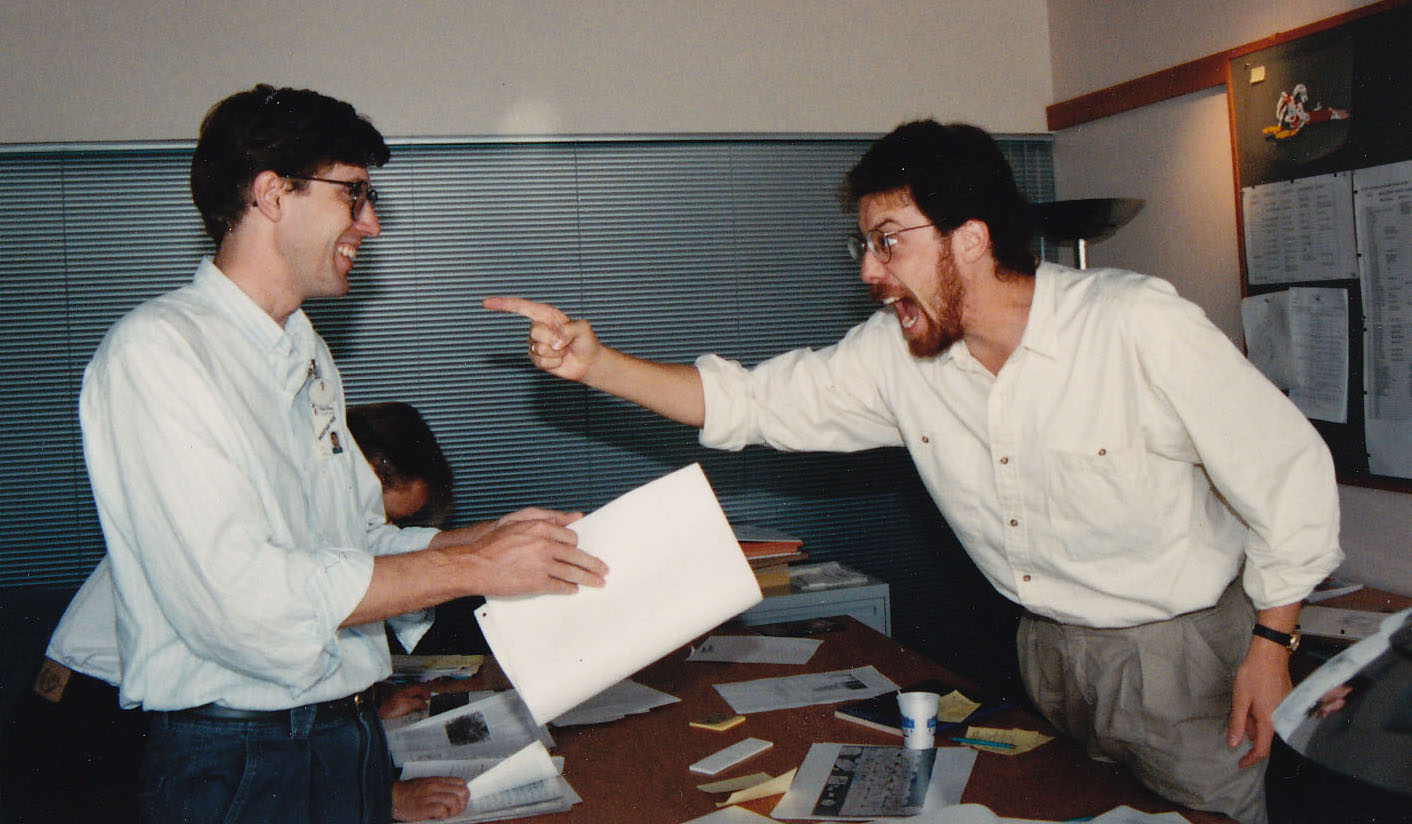
First of all, a HUGE public thank you to Jerry Beck, the patron saint of cartoons, for posting about Redux on his Cartoon Brew site. The ensuing avalanche of YouTube views exceeded 15,000 in 48 hours. Yikes!
So now that you've seen the film, here's some useless information to store in your head:
1. Most of the photo cut-out elements came from a Montgomery Ward catalog from the 1940's owned by production designer John Kleber. He xerox'ed the entire catalog for our production purposes. The catalog had live chicks, and kits to build an entire house yourself.
2. In order to sufficiently tone down his voice during the depressed Wolf scenes, Michael Richards recorded those lines while lying on the floor.
3. Grandma is a caricature of my maternal grandmother, Bertha Davis. She also appears in the movie Bebe's Kids.
Grandma Davis, left, with my Aunt Viola at Disney World's Contemporary Hotel, 1972.
4. The photo over Grandma's bed is my maternal great-grandmother, Louisa Schmickel, who lived to be 100.
5. Grandma's house is pink because she's a faded red. It's a color pun, a bad one at that.
6. Next to the door in the Wolf's garage is a shovel and two bags of sheep manure. A side business for Doris?
7. The boy in the photo on Grandma's dresser is my nephew, Henry Moore. In one shot, it is background painter Richard Morgan.
8. To entice Fabio to do the part, the Woodsman's role was padded by storyboard artist John Norton, who added the "Mr. Bunny Rabbit." lines.
9. Don Rickles couldn't keep our names straight, so he called us all "Richie."
10. In the final sequence, where hundreds of wolves make plans in the kitchen, there's a wall map with a red X. That address was the location of Toonz Animation in Auckland, New Zealand.
11. The final shot is a take-off on Alfred Hitchcock's final shot in The Birds.
Okay, that's eleven pieces of worthless trivia. I'm glad to have so much interest in a short I thought was forgotten. Thanks for watching and spreading the word.
In September of 1995, at Disney TV Animation, Veep Sharon Morrill asked if I would like to direct a Fractured Fairy Tales type of short, and have stylistic free reign.
"Say that last part again?"
Free reign. Go crazy with it.
And so I began working on Redux Riding Hood, a short that would take me to the sixth row at the Oscars. Dan O'Shannon, one of the top sit-com writers around, had written a script about a wolf who, obsessed with his failure to catch Red Riding Hood, builds a time machine to go back and do it right. It was Dan's concept, and the script was hilarious.
Even with a great script, there are plenty of ways for the final product to fail. I set to work on the big stuff: production design, cast, and musical score.
Redux needed a production designer who had never worked in animation, someone not schooled in animation history, not influenced by classic cartoons of yesteryear. Dan Rounds, who I'd worked for on A Goofy Movie recommended a fishing buddy of his in New Mexico named John Kleber. When I saw John's work I knew, from the color palette to the use of textural and photo collage elements, I had found my production designer.
John Kleber artwork. Pieces like this were the springboard to the Redux production design
The first thing John wanted to know was if there were animated films he should view as reference. "NO!" I said, and forbade him to look at ANY animated cartoons while we were doing this project. The only other limitation I put on John was, because of our schedule, the style would need to allow background painters to work quickly.
I had a few meetings with casting director Jamie Thomason, who questioned me about the characters - what kind of person was the Wolf, Doris, Red, Granny, etc. Once we had talked out who the characters were, the casting choices became self-evident. Michael Richards was the manic Wolf. Mia Farrow, as his long suffering wife (I made her a sheep, animation's first inter-species marriage.) I liked Mia's casual delivery and the sound of her plaintive voice was a great counterpoint to Richards' abrasive sound. Writer Dan O'Shannon hated Mia's Doris, because she didn't have that sit-com cadence. He wanted her recast, but I held my breath longer and won out. I could go on and on about the cast - Lacey Chabert, Adam West, Fabio, June Foray, Don Rickles - but for now I'll just say I hit the jackpot. And Jamie Thomason is truly brilliant. There's no one else I would want in a recording session than Jamie.
For music I wanted jazz great Bennie Wallace. I had met Bennie during the ill-fated Betty Boop feature in '93. He knows more about music than anyone I have every met. When I described the project and the off-beat quality of it, he brought me Charles Mingus' album Mingus Mingus Mingus Mingus Mingus. Like John Kleber's artwork, I was immediately inspired and excited as a new layer of the film revealed itself.
With Mingus as inspiration, Bennie set to the task, casting his musicians to get the right sound - among them Robben Ford on guitar, Emil Richards and his magic box of percussion instruments, Art Baron and his mad trombone, Alex Acuna brought a Latin beat on drums, and Bennie himself on Sax.
We recorded at Capitol Records in Hollywood, in Sinatra's old stage. As the musicians assembled, Disney's music veep Bambi Moe asked Bennie to see the cue sheets. When she saw them, her head exploded. "WHERE ARE THE NOTES?!" the large orafice on her head shouted.
Bennie laid on his Tennessee drawl. "Bambi, this is jazz." He said, "You don't tell these guys how to play." Bennie was right. He had indicated general timing cues and tempo, but the rest was improvised. When the musicians performed, it was magic. I got goosebumps, and was truly depressed when they finished. I wanted them to play all night.
Here's the end credit cue with full band. Bennie and Art Baron have a musicians' joust. The spontaneity of this could not have been reproduced from transcription.
Disney TV President Dean Valentine loved the music, but said, "Jazz is for having a cigar and scotch. Not cartoons." This time my head exploded. How could this guy be in charge of an animation studio and have no knowledge of the history of the medium? I was seriously outranked on this fight, and the score would have surely been scrapped without the intervention of Peter Hastings. Peter's One Saturday Morning cartoon block was a huge hit, so he was one guy who Dean trusted. Peter gave the score his approval, and it was saved.
Thanks Peter!
I got to spend five months in New Zealand for production - what a beautiful country. We did our best with a fairly green crew. Lily Dell did some amazing work on the Wolf and animated the Time Machine combining cut-outs and drawings. While in New Zealand, Jeffrey Katzenberg called me from DreamWorks. I thought it was a friend doing a prank, so I played along rudely. Then it struck me. "This really is Jeffrey Katzenberg."
"Yes it is," he said, "the horse's ass."
I have no idea how he found me, or that he even knew who I was. He wanted me to call him when I got back. I only mention it because it was so bizarre.
Back in the States, the post mix with Dave Stone's awesome sound effects - his custom made Time Machine sound is hilarious. We did some festivals, went to the Oscars, lost, and then the film was put away. Seven months after the Oscars, I was shown the door.
I won't go into that ugliness.
In the years since, Michael Richards had his infamous night club blow-out. Garrison Keillor, our narrator, has made some less famous blow-outs. I don't know if that has hurt the chances of a Redux release, but I hope not. No one at Disney or on my crew endorses the backward thinking of two actors in the cast. And while I dish about some now ex-Disney execs, in the big picture, Sharon, Bambi, Dean, and all the Disney brass were very supportive of Redux Riding Hood. They let me make this film. It would not have happened without their ultimate consent. For that I will always be appreciative. I'd like people to see it, so I post it here.
If you like Redux, show your support and join out Facebook page!
A few years ago I started helping out the Royal Parks Foundation by designing characters and logos for them - helping to raise funds for the Royal Parks, the green spaces that help to make London a liveable city. It started with Deckchair Dreams, an event which rounded up artists like Damien Hirst and Tracy Emin to design deckchairs to brighten up the parks in summer. The theme was flora and fauna so obviously I picked red squirrels - despite the fact that there aren't any in the parks; they've all been driven out by their grey North American cousins. Anyway you can still buy the deckchairs here if you fancy some designer artwork for your garden this summer.
Deckchair Dreams - perfect for your garden tbis summer!
This year, on October 7th they are planning a half-marathon through the parks, great fun and very picturesque (not like the full London Marathon which goes through some bits of the metropolis you'd rather forget). Last year someone ran in a full squirrel costume - obviously they were completely insane but amazingly the runner made it to the finishing line.
Squirrel costume optional
All of this is in the name of charities and good causes - and you can raise funds for any charity you like - not just the Royal Parks Foundation. Which gives you a marvelous opportunity to pester friends and family for cash. So much fun.
Ever since Kodak filed for bankruptcy in the US, a question mark has hung over its UK subsidiary Cinesite. Cinesite is an excellent visual effects house in London's Soho, one of the "Big Four" (including Frame Store, Double Negative, and MPC) which I worked at for many years. We animated hundreds of shots on Underdog, Beverly Hills Chihuahua and Marmaduke. Talking animals is not the most glamorous end of the VFX business but we took pride in building a highly efficient pipeline that could produce a huge amount of high-quality work in a very short time.
Some of the most fun I had there included working on the Harry Potter films - who wouldn't want to work on the series that has transformed the visual effects business in London? We did the magical tweeting birds from Harry Potter and the Half-Blood Prince - all beautifully rendered and suitable for an extreme close-up (though in the end we never got closer than a wide shot).
Working at Cinesite is fun in part because it still has the intimate feel of a small company - but with big, rich parents overseas, it was always protected from the short-term chill winds of the market. Now, with Kodak gone, it is having to fend for itself. Still, it was a surprise to see that a company which (according to yesterday's Sunday Times) made a profit of £2.7m on a turnover of £25.8m in 2010, has been sold to the private equity firm Endless for "around £2m".
Now, as every Londoner knows, £2m will barely buy you a house in the metropolis these days. Surely one of London's leading VFX houses is worth more than that?
Maurice Sendak invited me to lunch. I had been in the running to take over as director of the animated Where the Wild Things Are feature at Universal, which, after many many months of development, Maurice hated. He liked my take on Wild Things, and I had meetings at Universal and phone conversations with Maurice about how to put the project back on-track. Spike Jonze swooped in and made the film in live action, but on this day in August of 2002, I found myself driving down a small, windy road to have lunch at his house in Connecticut.
When I arrived, Maurice was a couple of hundred yards from his house, taking his daily walk. I complimented him on his place - a beautiful bucolic cottage with lush gardens. Maurice gestured with his cane to some very large nearby homes. "This was a great place to live until they came around." he said, slowly shaking his head, "McMansions!"
He gave me a little tour around the property. The walkway to the back door of the house led us through a rich, floral garden, for which he took no credit. "People come in and tend to it." he shrugged. He had an amazing collection of early Disney memorabilia with Mickey and Donald toys from 1930 made of celluloid - very rare. But what was truly mind-blowing was seeing his drawing table, where he had done so many books, and was working on his latest, Brundibar. He had a partially complete illustration on the table, and asked me to look through the other pages while he told me the story. I felt very self-concious, ol' Stevie Moore from a little hick town was now in the presence of artistic royalty. I flashed back to being in first grade, reading Wild Things in the library, and now here I was with the guy. Then he asked me what I thought of Brundibar.
Huh?
"It's your masterpiece." I said, terrified he might think I was laying it on too thick. He didn't. Even a 73 year-old legend likes to hear his work is good. Brundibar really is a masterpiece, by the way.
A lady magically appeared from the kitchen with salads for lunch. Maurice and I had a meandering conversation about the business of animation and the business of book publishing - they have a lot of the same problems with management driven creative decisions. He hated the trend in children's literature where famous people, like Madonna, were publishing books as vanity projects to impress their children. To Maurice Sendak, they made a mockery of his medium, the implication being that it took no real skill to write for children. He talked fondly of Ted Geisel, his friend. Dr. Seuss was probably the only one in his field who Maurice Sendak held above himself. He called him a genius, then chuckled at how he would taunt Geisel about his drawing ability.
He talked about authors he knew socially, like Kurt Vonnegut, but always felt treated like the kiddie-book guy. He never really belonged to the club. Maurice's intellect and wit was as sharp as they come, so he found this social snubbing quite demeaning.
His view of children was quite different from the consensus. He believed that children were not innocent, that innocence is a quality adults project onto them. Children had the same flawed character traits as adults, and that childhood was not full of wide-eyed, idyllic magic.
The conversation eventually found its way to Wild Things. He recalled the animation test done at Disney in the early '80's by John Lasseter and Glen Keane. He was talking about the same test that me and my CalArts classmates had drooled over twenty years earlier. Maurice not only disliked it, he hated it. Beautiful animation and breakthroughs in CG technology aside - the character was not Max.
He recounted how Michael Eisner pressured him to sell the rights to Disney. Over dinner, Eisner laid on the charm. At one point, he pulled out a checkbook and tossed it toward Maurice.
"What's this?" Maurice asked.
""You fill it out." Eisner said. "Any number you want. I want Wild Things."
Maurice had a general distain for pomposity. But instead of telling Eisner where to endorse the check, he made a proposition. "I collect Disney memorabilia. Rare stuff."
Eisner nodded, unsure where this was going.
"Back in the '30's, Walt and Roy Disney owned Duesenbergs with gold plated Mickey Mouse gas caps. There were only two made. They are the Holy Grail of Disney collectibles. Roy Disney has one, the other is in the morgue."
He paused for effect.
"Get me that gas cap and you can have the rights."
Eisner was completely gobsmacked. "I can't do that!" he said.
Maurice laughed, turning the knife, "You're Michael Eisner, the most powerful man in Hollywood! You can't get me a gas cap?"
Eisner's face flushed. "Okay," he said, putting away his checkbook, "I'll see what I can do."
A few days later, Maurice got a message from one of Eisner's secretaries. He couldn't do it.
Maurice reveled in stories like this, where bully-headed big shots get knocked down a peg. There was a wounded quality to Maurice that made him appealing even in his most bitter moods.
As happens in our business,when we stopped working together, we gradually lost touch. I tried to call once in a while, but felt like I was bothering him, even though he was always kind to me and my wife. He was one of the good guys, and I'm sorry to see him go.
The vast arch that leads into DreamWorks animation is even bigger than the one at Paramount - and this is surely not an accident. Few visitors can fail to be impressed by the sheer size and elegance of Jeffrey Katzenberg's Glendale animation studio. I was lucky enough to work there for many years on a number of projects including The Road to El Dorado, Spirit - Stallion of the Cimarron, and Sinbad. Not the most successful films that the studio produced, but all three crammed with excellent work lovingly hand-crafted by a hugely talented crew.
Don't you wish you worked here?
Ten years later, I want to slap my younger self for not appreciating it more, or for realizing quite how fortunate I was. Stepping onto the DreamWorks lot is an extraordinary experience - there are fountains, lakes, waterfalls, aquatic fowl nesting in the topiary, and paved avenues lined with trees. Little expense has been spared to create what is entirely mistakenly referred to as "a campus". Actually, it feels more like an Italian Renaissance town, complete with campanile, olive groves - and of course an excellent restaurant, which has the added advantage of being free.
Pressing the metaphor, all of this would make Jeffrey a sort of Prince of Animation, or at the very least a Grand Duke. The only thing missing is a cathedral (though a cynic might say that the screening theatre provides a substitute venue for worship). Actually, that would be harsh. It is easy to under-estimate the scale of Jeffrey's achievement - taking on Disney at their own game, and winning. His studio took a while to become a hit-factory but, like Pixar, DreamWorks has assumed Walt's mantle and inherited his legacy.
OK - I'll stop now
I was there last week meeting my old friend and colleague Nassos Vakalis for lunch - which was delicious. Nassos is an excellent animator and story board artist who draws with fluency and skill and has a fine sense of camera and shot progression. We first worked together at Warner Bros Feature Animation - another studio which tried (and failed) to emulate Disney's success. I have always been envious of Nassos's ability to capture an idea in a few lines, and his creative energy. Here's a link to a trailer to his latest short film, which looks very charming. It has been winning awards in animated film festivals all over Europe.
Some dinosaurs, including Andreas Deja, Nik Ranieri, Raoul Garcia and Charles Solomon. Tom Sito is behind the camera.
Animation critic and historian Charles Solomon kindly set up a lunch for me last thursday with some old Disney kumrads, at a burger joint in Toluca Lake called The Counter. A "Dino's lunch" is an irregular gathering of wizened 2D animators (ie dinosaurs), most of whom I haven't seen in many years. We used to meet at Mo's in Burbank but they have since dropped curly fries from the menu - obviously this was just one step too far and we Dino's have been forced to take our custom elsewhere.
It was great to see so many familiar faces. Andreas Deja was there, whose awesome blog Deja View you can see here. Andreas recently left Disney after decades of dedicated service, along with fellow uber-animator Glen Keane. It looks like the recent brief revival of 2D animation - which culminated in The Princess and the Frog - under John Lasseter's leadership has already burned itself out, and there are no 2D projects on the horizon.
The end of 2D animation at Disney?
What a sad end to the world's finest tradition of 2D animation. And especially confusing since I am told that the re-release of The Lion King in 3D made $100m at the box office - so there must be some life left in hand-drawn animation yet.
Anyway, here's a photo of some of the Dino's, including - in no particular order - Andreas Deja, Tom Sito, Raoul Garcia , Nik Ranieri, and Charles Solomon. Many thanks to Charles for bringing everyone together. He is a wonderful writer and you can pre-order his latest excellent book here:
"Don Hahn and I will be doing another evening of Disney Rarities at the Newport Beach Film Festival this Wednesday, May 2, 2012. This is our 5th year doing the festival and we have put together a great show with some rarely seen Disney bits. If you are around Newport Beach on Wednesday, drop by for a fun screening at the Lido Theater, at 7:30."
Dave, Don, and Roy Disney screened my short "Redux Riding Hood" back in '07 - the first screening in nearly ten years. This may be your only chance to see these films on the big screen. If you're in Southern California, don't miss it! - Steve
"The iPhone/iPad app market is growing daily, and we wanted to experiment with something that would be graphic and simple as there are currently some limitations on the amount of full animation that can be accomplished. Our intention for creating a storybook app was to make something fun and educational for kids that would deliver interactivity not achievable with the traditional book format.
We came up with the My Beastly ABCs concept to design stylized creatures from around the world, interwoven into a story of a boy who has difficulty getting to sleep because of the beasts he encounters. The viewer is able to interact with the beasts and discover, as the boy does, that they are not to be feared. The goal is to not only encourage kids to read, but to create an enjoyable piece of entertainment with a comprehensive narrative.
We were very fortunate to get Jim Dale, world famous narrator of the Harry Potter books, on board as our story's reader/performer. He narrates the story from the boy's point of view, an adult looking back at a time when he was young. The entire process, so far, has been very gratifying because we were able to conceive and approve ideas with a small crew, not with a long, multi-layered approval process.
The current plan is to release the app later this summer. We recently launched a Kickstarter campaign to raise funds to complete and market the project at the highest quality level possible. The desire is for our studio to continue developing more original apps, with a focus on personalities and unique styles."
Visit Ken's Kickstarter page and donate if you can.
Roger Rabbit by Rob Minkoff - Rob corrects my animation drawings
One of the best things about working at Disney MGM Studios was being able to go on all the rides for free. In the evenings after work the Park thinned out and, as employees, we could come and go as we pleased. My personal favourite was the Hollywood Tower of Terror a fantasy ride based on the old Twilight Zone TV series. I rode it endlessly and could never get enough of the butterflies-in-the-stomach final plunge.
Me at my Disney-MGM desk, animating a scene from Rollercoaster Rabbit
In the summer of 1989 I managed to get a job as an animator at the newly built Disney MGM Studio Theme Park in Florida, set up by "Who Framed Roger Rabbit" Production Manager Max Howard. Max was hired by Disney to build the new studio from scratch, and he quickly set about making a series of short "Roger Rabbit" films with his enthusiastic but fairly inexperienced crew.
Kelly Asbury - loving his new jeans
Part of the Studio's production expenses were paid by the Park itself, as visitors would pay to watch the animators at work. We called it the goldfish bowl - guests would walk through the studio all day long and watch us draw. The inexperienced and the unlucky had to sit by the window - closely supervised by camera-wielding tourists.
Some of the animators claimed to be able to line up dates by gradually moving through the studio exchanging nods and winks and finally phone numbers with the girls "on the other side". For me it was heaven - my first proper animation gig since Who Framed Roger Rabbit?, a paid summer job in a sunny paradise and a chance to learn and get better at my craft.
Rob Minkoff tells Jim Beihold a thing or two
We were led by the incredibly talented Rob Minkoff - who patiently took the trouble to fix my drawings and squeezed far better work out of me than I thought I was capable of - invariably the sign of a great director.
Master Animator Mark Henn - quality and speed
Lots of extremely able artists got a head start at Disney MGM Studios. I was lucky enough to work with Kevin Turcotte, Kelly Asbury, Mark Henn, Jim Beihold and Tom Bancroft, among many others who brought their huge talents to the studio.
It was a huge privilege to be there and like everyone else who passed through its doors I thought it was a tragedy that such an excellent studio was eventually closed down by Disney.
-Alex
You can see the second part of this article about Disney MGM studios here, and read more about it in this classic FLIP article.
Last week, I was in Hollywood visiting friends and taking in some sights with my family. One of our last stops was a trip north to my old alma mater, CalArts. It had been at least twenty years since I last set foot on campus. At the gatehouse, I showed the guard my old ID. He laughed, said "This was three years before I was born." and opened the gate. Asshole.
Seeing the campus was like taking a time warp from 1985 into the 21st century. There's the original buildings, same old parking lot, same old eucalyptus trees, but it's dressed up with new stuff. There's a funky performance hall for the music department with a small outdoor amphitheater just to the left as you drive up.
The main entrance steps are where I once met Terry Gilliam, who was screening his new movie "Brazil" at the tiny Bijou theater on the second floor. I couldn't get in, there was such a crowd. But Gilliam was standing out on the front steps having a smoke. He chatted with me and a couple of other guys about his battle with Universal over the film cut. I thought my geek head would explode. That's the kind of cool stuff that happened at that school - geek moments with great artists.
Walking through the main building, its almost exactly the same - same signs, same color coding for the different floors. The sub-level was still covered with graffiti. The students still had that unfed, unbathed look.
The second year Character Animation room still had sophomores in it, but no animation desks. They were working on Cintiqs atop two rows of fold out tables. It was Sunday morning, so only a few students were up and working - they had clearly been up all night. One student was asleep on her desk. Another student was nice enough to listen to me yammer on about "Well in my day, we used an Oxberry!" while thinking, "I have to finish my film by Friday, please shut up, old dude."
The dorms were mostly the same. The jacuzzi's been filled in - no doubt by the health department. One the east side parking lot, the sprawling lawn has been replaced by ugly, pole barn style buildings with industrial metal siding. They're small sound stages.
Driving off the lot, I thought of my old teachers: Jack Hannah, Bob McCrea, T.Hee, Hal Ambro, and Elmer Plummer, all gone now. They worked with Walt Disney himself, and often treated us to personal anecdotes about The Man.
As I drove down Lyons Ave, to the strip mall where Vincenzo's Pizza and Mongolian Barbecue still catered to student appetites, I thought of my classmates: Brenda Chapman, Fred Cline, Butch Hartman, Tim Hauser, T. Dan Hofstedt, Mark Kalesniko, Dan Jeup, Kevin Lima, Rob Minkoff, Kirk Wise, and many others who have gone on to be industry leaders. CalArts was as much a growing up experience as anything else. I didn't fully appreciate it then, as I was too busy being a "stupid animator" as we were often called by the other departments. We were goofy, travelled in packs, and totally immersed in character animation, 24/7. Paradise, man!
The Faberge Big Egg Hunt is almost over - bids close on Easter Monday for your chance to own a one meter high hand painted fibreglass egg - how can you possibly resist? All the eggs have been gathered together in Covent Garden over the Easter weekend for one last push to break the world record for the world's largest-ever Easter Egg Hunt. Some of them are truly amazing - my personal favourite is "Pandora" - hand painted by the very talented wildlife painter Martin Aveling. The photo doesn't really do it justice - the surface texture has been beautifully rendered so it looks and feels like a real giant egg.
And I was thrilled to see that my egg - The Great Eggscape - is still alive after 6 weeks in the rain - apart from a few sticky handprints it was completely unscathed. One wet cloth and a gentle scrub later and it looks as good as new.
Sarah on egg cleaning duty
Bids close at 5pm on Monday 9th April. Go on....you know you want one! - Alex
I had my first gallery show last month and want to show off my posters. But first, backstory.....
Oyster heyday of the Delaware Bay
I live in Port Norris, in southern New Jersey, where the Maurice and Delaware Rivers meet. A hundred years ago, it was an oysterman's paradise. Hundreds of schooners under sail dredged enough oysters to fill 300 train cars every week during the season. In the 1950's, a disease decimated the oyster beds. The town was ruined. In 1962 I was born. I would grow up watching once proud ships dissolve in the muddy banks and buildings vanish in the marsh on which they had been built. In 1981, I got the hell out.
The schooner A.J. Meerwald
Fast forward to the 1990's. A woman named Meghan Wren created a non-profit called The Bayshore Discovery Project out of her love for the river. The group purchased a 1928 schooner called the A.J. Meerwald, which they restored to its 1928 self. They also purchased a waterfront building known as The Shipping Sheds. This is where, in the heyday, the oyster boats docked, the oysters placed in barrels, then loaded onto awaiting train cars.
After many years of slow, steady progress, and lots of volunteer effort, these sheds have at last been restored, and are now used for educational purposes as well as social events. Last fall they began a monthly Second Friday event, where there's music, fresh shucked oysters, art, and hanging out at the docks by the river. A very nice night out.
The Shipping Sheds then and now.
So when Meghan asked if I would design a sign for their new cafe, The Oyster Cracker, I jumped at the chance to be part of this cool place. I used the opportunity to try different styles, playing on my Cintiq. There were enough ideas for a poster show as part of their Second Friday event last month. They were very well received and we sold almost a dozen prints. Check them out, FLIP friends!
Cracker Box Royster
R. Crumb Jesse
Super Oyster Silhouette
Folk Art Rebus
Linocut Red Linocut Blue
They're available for purchase, $60 for an 18 X 24" print. A third of all proceeds goes to The Bayshore Discovery Project. A third goes to the print shop. And a third goes to the Steve Moore beer fund - please give! Order now! Maureen at the Bayshore Discovery Project is standing by. Click here!
According to The Guardian, last week's UK budget will bring huge tax relief for British animators, in an effort to stop jobs and production moving overseas. Details of the new proposed tax break are a bit sketchy, and will be subject to obtaining state-aid approval from the European Commission. If all goes well, UK production of animation will qualify for a 20% or 25% break depending on the production budget. Combined with the EIS tax incentive scheme this could be a really important boost for our industry. - Alex
I recently stumbled across Andreas Deja's blog - Deja Vu - which is crammed with excellent posts, especially on Disney's Nine Old Men and their enduring legacy and contribution to the craft of animation. Twenty years ago I was lucky enough to have the opportunity to work with Andreas on "Scar", the character he designed and supervised on the "Lion King". Andreas was kind enough to let me join his team one summer at Disney in 1993 when I was still a student, eager to spend a summer working in LA to try to get better at animation and to earn some spare cash. Looking back now I can't believe how lucky I was - or how little I really knew. Despite my stumbling inexperience, Andreas was a generous mentor and under his careful guidance I managed to complete a number of shots on the film, work which I am still proud of 20 years later.
I learned a great deal from Andreas, but the most important thing that he taught me was that no matter how good you are as an animator - and he is very very good indeed - we all stand on the shoulders of giants. Andreas's fascination with the work of Disney's 9 Old Men shows how much we can still learn from the Golden Age of Animation - if we will just take the trouble to study it.
My wife, Donna, and I did not have health insurance when she was diagnosed with cancer last year. (see earlier post.) She had left a job with insurance, and was looking into buying private insurance when it all hit the fan.
Thanks to the Affordable Health Care Act (a.k.a. ObamaCare), we were able to get insurance even with Donna's pre-existing condition. If opponents of this law had had their way (and they eventually may), we would have been denied insurance, and would have faced severe financial stress while trying to fight a life threatening disease.
There's been an awful lot of nasty rhetoric being tossed around, decrying this law as unconstitutional. An invasion of privacy. An attack on our freedom.
I thought they were talking about Facebook.
This is about health insurance. Not Communism. Not the Taliban. Not gay whales. Not Mo-Cap. Health insurance. We are being forced to get insurance. Insurance companies are being forced to insure the sick. That's the deal.
Some gnash their teeth in panic, imagining that their fears and prejudices come to life and gang-bang them in the name of ObamaCare. Donna and I experienced this law in the real world, first hand. It helped us. That's not a Democratic thing nor a Republican thing. It's a human thing.
-Steve
Another awesome student film from The Animation Workshop - the hilarious Space Stallions, produced by another talented crop of recently graduated Danish film-makers. I have been coming to teach at the Animation Workshop in Viborg, Denmark for many years now, and I always love coming back; the school has a terrific energy and has become one of the best places to study animation in Europe. All classes are conducted in English, and international students are welcomed. The school has recently added a CGA (computer graphics art) course with a strong emphasis on technical skills, and the CG artists work together with the animators in their third year to produce a "bachelor project" - a final year film which aims to combine excellent animation and story telling with a high level of technical skill. Every year the films seem to get better and better, and the recent results speak for themselves. Enjoy! - Alex
My old chum Butch Hartman is chumming for new talent. Butch has become the King of Cartoons at Nickelodeon with his Fairly Oddparents, Danny Phantom, and T.U.F.F. Puppy series getting heavy rotation in the programming day. And yes, I have given him grief over the obnoxiously loud soundtracks in his shows, but he's still kind enough to listen, then tip me for polishing his Bruno Maglis.
He has launched the YouTube channel "YooToon Studios". Butch explains:
"YOOTOON STUDIOS is an area where aspiring animators of every age, shape and size can get their work seen by Hollywood professionals. If their videos get lots of attention we'll give them a small budget to make even more! The bigger the audience, the bigger the budget! Also, I'll be doing my own original stuff, too. Videos should be between 10 seconds and two minutes, ideally. But, hey, if your genius exceeds two minutes, let's see it anyway!"
And that's the carrot in a nutshell. Get to it, kids! -Steve
Those were the words of Ward Kimball, spoken in 1980 to a small theater full of Cal Arts students. He might as well have been preaching atheism in a cathedral. Students were not only hurt, but outraged that this "nine old man", this apostle of Walt, could deny their dreams of Walt's Second Coming. They were, after all, the new generation being groomed to restore and continue the Walt Disney legacy.
Thirty two years later, that generation is still dreaming. In the Fantasy Disney Studio in their minds, Glen Keane, Andreas Deja, and seven other guys become the new nine old men, and John Lasseter becomes Walt, bringing back old school animation for good, and the artists move back into the old animation building, with the old desks, and marry ink and paint girls, and have lunch at Alphonse's and martinis at the Pago Pago. Sigh.
When Glen Keane announced last week that he was leaving the studio, a chorus of shrieks rang out. How could he do that? The blablogs were on fire with comments on his announcement - barking up opinions as if Glen actually owed them an explanation for what was, in fact, a personal decision.
I don't know Glen, personally. But I know he's done the best character animation of his generation and has nothing to prove. He gave thirty six years to a studio that, during his tenure, grew, as if on steroids, into a pumped-up, corporate soulcrusher. They'll go on making animated films (or not), but its homey, midwestern roots are gone, save for some very nice people working there, dreaming, dreaming, of the Fantasy Disney Studio in their minds.
Good ol' Brenda Chapman has announced the launch of her own website: www.brenda-chapman.com/. And like everything she does, she did it right.
Brenda had this to say about it: "I've learned that I really enjoy writing. It's a good place to try things out. And it's a chance for me to give a little back. I will never ever ever ever live up to Joe (Ranft) and his generosity with people who went to him for advice. He never turned anyone away who wanted his mentorship. I don't know how he did it, or found the time - but he did. So if I can do that on my own small scale, it's really to honor Joe. - I don't mean to sound mushy or mundane, but again, there it is."
I've known Brenda since we were CalArts kids. Even in her student work she brought a humanity to her characters that played very real. That's not something you can calculate, it has to come from the heart. Few people in our business can tap that, but she can. While the rank and file in our industry are busy aping each other, she brings her own perspective to her work.
Even though I have spent 20 years in the animation business, I had a short lived career in the early 90's as a barrister - that is to say a lawyer of the wigged variety - made famous (ish) by John Cleese in A Fish Called Wanda. I still write and draw a weekly cartoon strip about lawyers in The Times - you can see it at www.qccartoon.com - the site is full of law jokes, law cartoons, and law humour. And, from time to time I publish a new collection of the cartoons for my legion of fans (my Mum and her friends).
My latest book, published by the excellent JR Books, is a collaboration with the hugely talented American writer and ex-lawyer Daniel R. White - who is the main reason why The Official Lawyer's Handbook is as good as it is. Anyway this is my favourite book so far, and even if you don't think lawyers are funny, you still might enjoy laughing at them, especially if you have recently emerged from divorce or bankruptcy. You can find the book here at amazon.co.uk, and I hope you have as much fun reading it as I had writing and drawing it - Alex
One of the many privileges of our business is the pleasure of working alongside talented colleagues. I first met Sydney Padua at Warner Bros where we worked on Brad Bird's wonderful Iron Giant. Since then we have bumped into each other on many animation and VFX features including most recently The Chronicles of Narnia - Voyage of the Dawn Treader, where Sydney did some beautiful character work on Eustace, the dragon.
Syd does not neglect her own personal projects and has developed her own highly successful online web comic about the Victorian inventor and computer pioneer, Charles Babbage. The Thrilling Adventures of Lovelace and Babbage has developed a huge following and even the science establishment is very keen to get involved - making science interesting for kids. She recently did a TED talk which you can see here. Syd is an inspiration for every animator who dreams of getting on with their own personal work - while simultaneously balancing the need to do commercial work and of course earn a living. Her web comic is beautifully drawn and very funny, and you can find it here. Personally, I can't wait for the graphic novel. Enjoy! - Alex
I didn't see John Carter. But I have worked on my share of flops. My heart goes out to the really talented people who poured so much of themselves into a production like that. It's like you've raised a child to walk the high wire, and on his first step out, he falls to his death.
Peers stare in silence. They'll mumble privately to each other, "The kid was too fat." or "The kid didn't know what he was doing." or "They should have given the kid a better name." but publicly, there's an awkward silence. They put their heads down and go back to work.
When one of our peers fails, there's a shiver of fear that resonates through the creative ranks. In our industry, failure is made very public. Media people seem to drool over the opportunity to take smug, dismissive shots at a movie that didn't work. They haughtily highlight every flaw, and belittle the filmmakers for their incompetence. People all over the world get to witness this beating to their own amusement, adding their own asinine comments without the slightest idea that the movie was made by good, talented people who just couldn't make the sum of the parts come together as a whole.
And then there's a private fallout in the studio. Studio brass forget your name. Your agent forgets your number. Friends forget to be friends, wanting to avoid any conversation about the whole mess. Is it any wonder that creative people are afraid to take chances?
In FLIP #17, director Dan Scanlon talked about the fear of failure in the industry:
"I find a lot of professionals artist are afraid to make something on their own because they fear it won't live up to the standard of the projects they contribute to at work. They're afraid when people see what they create without the company behind them. Afraid it will appear that they're the one who's been pretending to help lift the couch. But remember, the projects you work on professionally are made by many, many, extremely talented people, but that doesn't mean each one of them should be able to take the reins and knock it out of the park on their own. Give it a shot, and if you fail - so what? Revel in it, and most importantly, learn from it and do it again. Besides, even if your peers say your project sucks, take comfort in knowing they're still secretly jealous that you made something."
Dan was talking about independent filmmaking, but the fear that he speak of - of not being able to succeed outside of the walls of the animation studio - still applies. The comfort zone of a big studio is hard to step away from, particularly as you get older and have families to support. The goal shifts from having a career in animation to having a job in animation. It's just how it is.
But for me, the real fear is not failure, but getting too comfortable. I remember my early years in animation, encountering old veterans with tons of great advice on technique, but terribly stale creative ideas. I felt kind of bad for them, worse than I feel for Andrew Stanton, the director of John Carter. At least Andrew was trying something different. He took a big chance on a very big stage.
One of the problems that the Visual Effects business in London has had for many years is how to find suitably trained animators - photo realistic creature work is very demanding and the skills involved can be quite different from animating character performances. One school that offers an excellent training (at very reasonable rates) is Rob Hemmings' admirable Animation A-Team. He focuses exclusively on training animators for creature work, aiming squarely at the likes of Frame Store, Double Negative, MPC and Cinesite. The reels his students come up with are hugely impressive - you can see their work, and his website here: Enjoy! - Alex